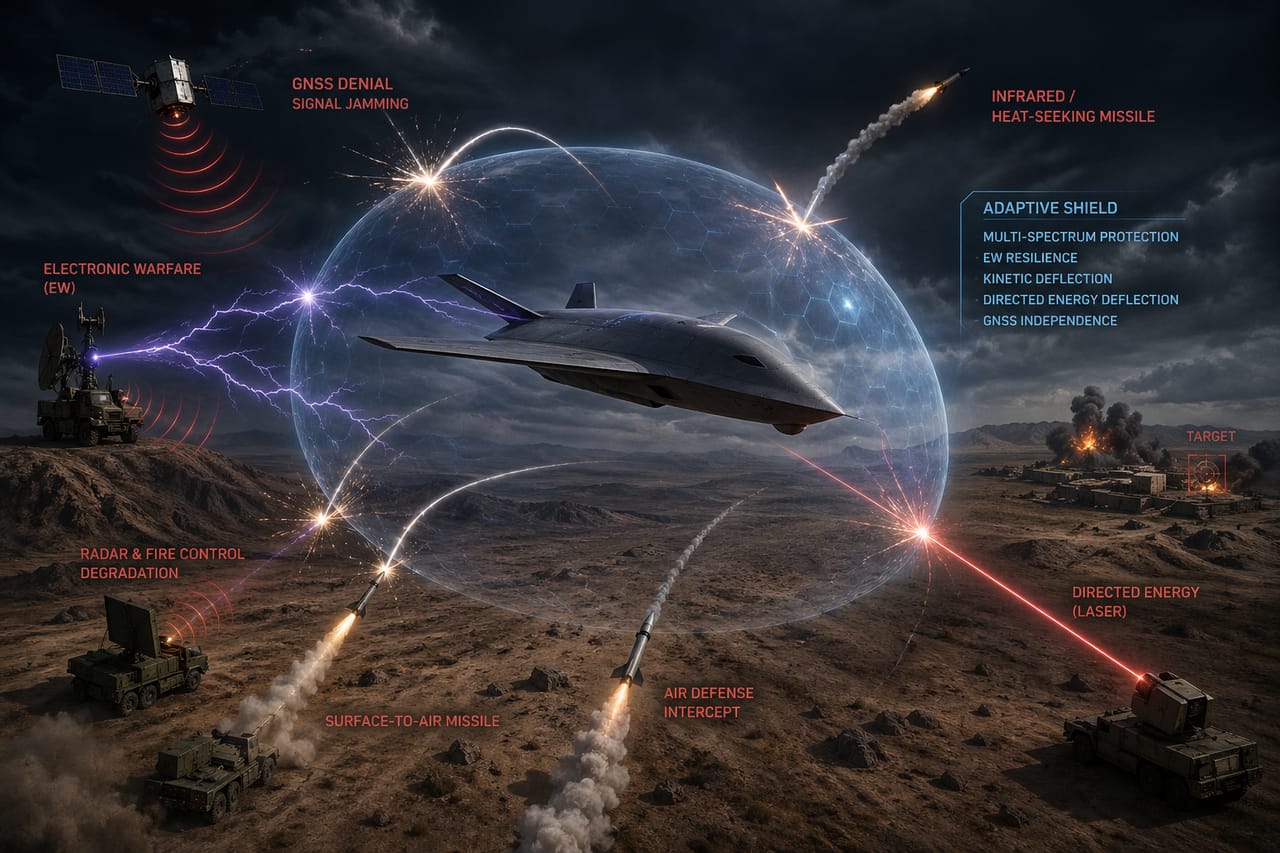
The Illusion of Immunity
The screens showed confidence. Dozens of UCAVs advanced in perfect geometry, silent, coordinated, supposedly unjammable. Their manufacturer had promised immunity: adaptive links, autonomous navigation, AI-driven resilience. The operators on the defending side did not panic. They did not reach for a bigger jammer or a louder signal. Instead, they did something deceptively simple.
They let the swarm believe it was succeeding. They observed timing slips, micro-corrections, decision hesitations at the edge of autonomy. Then a single, low-power transmission appeared, not noise, not denial, but a carefully timed lie. A ghost reference. A subtle bias. The swarm adapted, as designed, and in doing so, amplified its own error.
A few vehicles peeled off to “re-stabilise.” Others slowed to re-synchronise. The formation fractured, not because it was jammed, but because it was out-thought. Within minutes, the swarm defeated itself, chasing coherence that no longer existed. No brute force. No headline-grabbing technology. Just human ingenuity exploiting assumptions embedded deep inside “unjammable” code.
There is no such thing as jam-proof. Only untested.
What Jamming Actually Is
Jamming is often misunderstood as raw power, overwhelming the spectrum with noise. In practice, effective jamming is far subtler. It is the deliberate shaping of the electromagnetic environment to deny, degrade, deceive, or delay an adversary’s ability to sense, communicate, navigate, or decide.
The most effective jammers exploit structure, not strength: waveform dependencies, timing assumptions, protocol behaviour, and operator expectations. Counter-jamming, therefore, is not a checkbox feature or a single algorithm. It is a layered design philosophy.
Waveform Agility
Frequency-hopping and spread-spectrum techniques that deny a jammer a stable target.
Spectral Diversity
Operating across multiple bands simultaneously so denial of one path does not silence the system.
Signal Redundancy
Multiple independent navigation and communication paths, GNSS, INS, optical, RF, with autonomous failover.
Processing Resilience
Signal processing architectures that gracefully degrade rather than catastrophically fail under partial denial.
Every layer of counter-jamming protection introduces new structural assumptions, and every structural assumption is a potential attack surface for a thinking adversary. The goal is not invulnerability but rather making exploitation sufficiently costly and time-consuming to deny tactical advantage.
An Endless Game, by Design
Jamming, counter-measures, and counter-countermeasures form an endless evolutionary cycle. There is no final victory, only temporary advantage. Every GNSS fallback, swarm autonomy mode, and hardened data link introduces new dependencies. These assumptions are observed, learned, and deliberately exploited by a capable adversary.
The history of electronic warfare is a history of this cycle repeating at faster and faster timescales. What was state-of-the-art protection in 2020 may be a known vulnerability by 2025. Procurement timelines that deliver systems 7 years after specification are delivering systems whose EW resilience was designed against a threat environment that has since evolved two full generations.
In the electromagnetic spectrum, immunity is never a property of a system, it is merely the delay before a thinking adversary discovers your assumptions.
What Adversaries Actually Do
Against a “jam-proof” swarm, a sophisticated adversary does not reach for a larger transmitter. They:
- Observe and characterise the swarm’s communications behaviour before acting, mapping timing, frequency usage, and redundancy patterns.
- Inject subtle deception rather than overt denial, ghost references, spoofed GNSS signals, false network synchronisation beacons.
- Target the autonomy logic, forcing the swarm’s AI to make decisions based on false environmental data, turning its own adaptation mechanisms into liabilities.
- Attack the edges, the handoff between autonomous and operator-controlled modes, where assumptions about the operational environment are most rigid.
The Human in the Middle
The most dangerous weapon in electronic warfare is a thinking operator.
The most effective outcomes in EW history did not come from perfect hardware. They came from operators changing routines at the last second, engineers deliberately bending their own systems to expose adversary assumptions, commanders exploiting adversary overconfidence, and teams recognising when not to transmit at all.
Emission control, the discipline of knowing when silence is more powerful than transmission, remains one of the most undervalued EW skills in the drone era. A swarm that transmits continuously to maintain cohesion is a swarm that is continuously advertising its presence, protocols, and vulnerabilities.
AI-driven autonomy in drone swarms is designed to reduce the cognitive burden on human operators. This is genuinely valuable. But autonomy designed without deep integration of human judgment at critical decision points creates systems that are predictable, and predictable systems are exploitable systems.
Operational Reality
Without deep exposure to real threat emitters and their constraints, contested propagation environments, multi-domain coordination, and adversarial tactics, techniques, and procedures, drone systems remain laboratory-successful but operationally fragile.
In contested airspace, UCAV swarms are not defeated solely by denying signals. They are defeated by shaping what the swarm believes to be true, forcing it to adapt, fragment, or hesitate at a moment of the defender’s choosing.
The moment a product specification claims “jam-proof” or “unjammable,” it signals one of two things: either the engineers have not tested against a sufficiently capable adversary, or the marketing team has overridden the engineers. Neither is a position of strength in a defence procurement conversation with operators who have actually been jammed.
Conclusion
The electromagnetic domain is alive, adaptive, and contested. It does not respect marketing claims or procurement timelines. The moment someone claims to have made a system “jam-proof,” they have likely misunderstood the nature of the spectrum itself.
Those who truly understand jamming rarely speak in absolutes. Those who do, often have not yet been challenged by a real opponent. The appropriate claim is never “unjammable”, it is “resilient enough, for long enough, against a defined threat, under defined conditions”.
That framing is less exciting in a brochure. It is, however, the only framing that survives contact with an adversary who has read the same brochure and spent six months figuring out how to use it against you.