The order book that should not be possible
Six months into the Gulf war of 2026, the data on Bharat Dynamics tells an unusual story. The company’s order book stands at Rs 26,176 crore, nearly eleven times its FY26 revenue. Yet capacity utilisation is stuck at around 60 per cent, and revenue actually fell 27 per cent for the year. Management’s own explanation, given to analysts, is delays in component integration from external vendors.
Read that again. India’s premier missile-assembly PSU is not short of demand, orders or factory floor. It is short of suppliers.
India’s missile industry is not short of orders. It is short of the vendors who make what goes inside them.
The world just spent six months watching the United States burn through two thirds of its Patriot interceptors with no way to replace them quickly, because Patriot production depends on a narrow base of specialised sub-tier vendors that took decades to build and cannot be improvised. India is staring at the same structural problem, just earlier in the story.
That is bad news if you are planning to fight a war. It is very good news if you run a precision-engineering, electronics, chemicals or materials business and have been wondering whether defence is a market worth entering.
The bottleneck is not at the top of the pyramid
When people imagine “getting into defence,” they picture becoming the next HAL or BDL: designing a missile, winning a DRDO contract, competing with giants. That is the wrong mental model, and it is why most MSMEs never try.
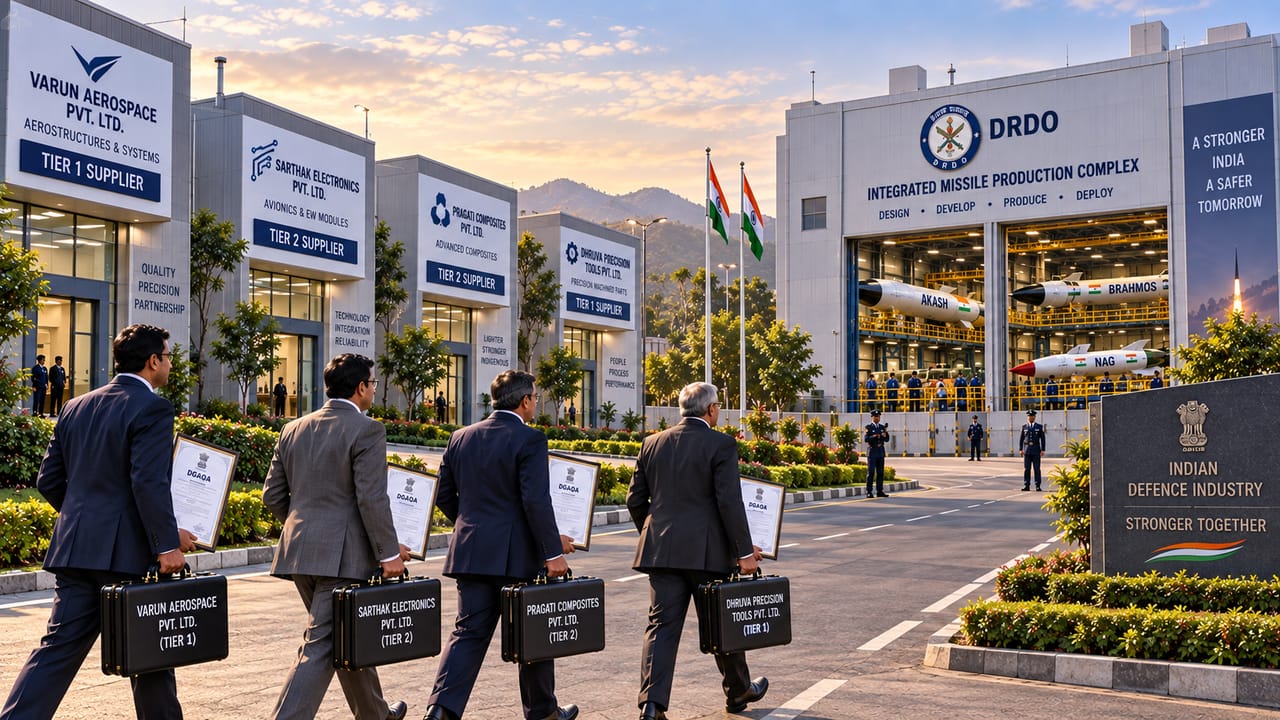
Defence manufacturing is a pyramid. At the top sit the OEMs and system integrators: BDL, BEL, HAL, and private primes like L&T and Tata Advanced Systems. Below them sit Tier 1 companies making major sub-assemblies, and below that, Tier 2 and Tier 3 vendors supplying machined components, castings and forgings, electronic sub-assemblies, cable harnesses, fasteners, seals, springs, connectors, precision optics mounts and specialty chemicals. A missile has thousands of parts. BDL and BEL do not make most of them. They assemble and integrate what a very thin layer of vendors supplies.
That thin layer is exactly where the war has exposed the weakness, and exactly where an existing industrial company, one that has never touched a defence contract, can walk in.
You Are Already Inside This Problem
If your company already runs CNC machining, wiring harness assembly, chemical formulation, EMS or precision casting for automotive, pharma or aerospace customers, you are not starting from zero. You are one qualification cycle away from being part of a supply chain that the country, right now, urgently needs to be deeper and wider than it is.
What the bottleneck map actually means for you
A recent strategic study of India’s defence-industrial exposure during this war mapped out, subsystem by subsystem, where the supply chain is thin. Read as a threat assessment, it is sobering. Read as a market map, it is an opportunity list.
Precision Machining
Motor casings, flow-formed tubes, launcher structures, fin actuators, gimbal housings. Any general-engineering firm with CNC capability and tight tolerance control can qualify. This is the lowest-barrier entry point in the entire chain, and India already has the deepest civilian base to draw on, from auto-component makers to machine-tool shops.
Castings and Forgings
Maraging steel, aluminium and titanium components. MIDHANI cannot be the only source forever. Foundries and forging houses already serving aerospace, energy or heavy engineering have transferable capability.
Cable Harnesses and Connectors
Every missile, radar and fire-control system is wired together by hand-built harnesses to exacting standards. Labour and process intensive, not capital intensive, and a natural fit for India’s large electronics assembly and wiring-harness base already serving automotive and appliances.
PCB and RF Sub-Assembly
India has almost no domestic source for FPGAs, GaN or GaAs RF devices at the chip level, and that gap will not close soon. But board assembly, RF module integration and EMS work around imported chips is real, immediate, and open to the same companies now doing OSAT and contract assembly for Micron, Kaynes and CG Power.
Specialty Chemicals
Ammonium perchlorate, HTPB binders, insensitive explosive formulations. Premier Explosives’ managing director has told investors, on record, that there is no alternative supplier for QRSAM’s propellant. One company as the sole qualified source for a flagship national programme is not resilience. It is an invitation to any chemicals company with the right licensing to become the second source India badly needs.
Seals, Elastomers and Composites
Radomes, gaskets, thermal protection, insulation. Straightforward for firms already serving auto, industrial or aerospace sectors.
Testing and Certification
As more vendors enter the chain, someone has to test their output to DGQA and CEMILAC standards. Independent testing labs are themselves a scarce and underexploited business opportunity.
Getting in
This is where most companies stall, not because the technical work is beyond them, but because the entry process is unfamiliar. It comes down to five moves.
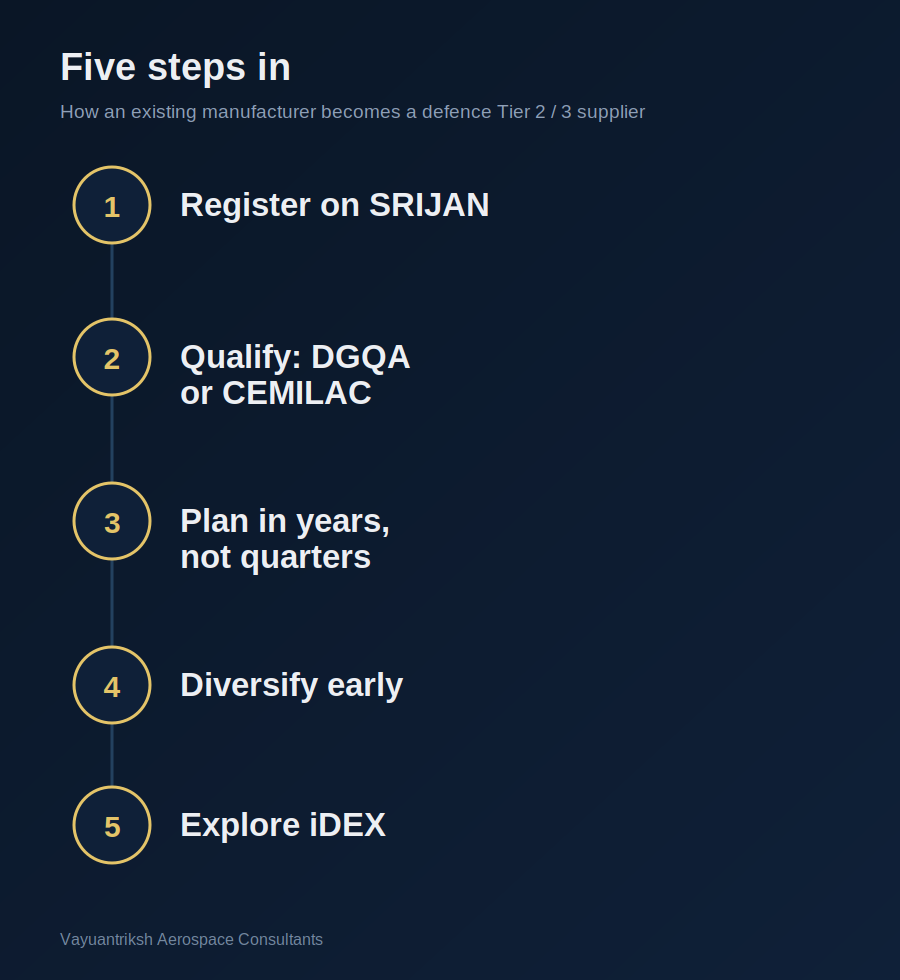
If you already supply automotive OEMs, pharma or aerospace, your quality systems are probably closer to defence-ready than you think.
The Saudi warning: money cannot buy what industry cannot make
While this piece was being finalised, the clearest illustration yet of the argument above broke in the news. On 17 September, the Associated Press reported that Saudi Arabia has approached France, Britain, Pakistan and Egypt for air-defence assistance because its own stock of missile interceptors is running low against escalating Houthi attacks. A booby-trapped drone was intercepted near Makkah on 15 September, the Houthis claim to have shot down a Saudi F-15 over Marib, and one regional official described Riyadh’s position as “very difficult.”
Here is the part that should concentrate minds in Indian industry. Saudi Arabia is not a poor country improvising with scraps. It has one of the largest defence budgets in the world, a decades-long relationship with the United States, and a treasury deep enough to buy almost anything money can buy. And yet, according to the same AP report, the United States, Saudi Arabia’s main arms supplier, is itself short of interceptors after months of fighting Iran, and cannot simply hand over more. European officials have separately acknowledged interceptor shortages of their own, limiting what NATO members can spare. Even the newly signed Makkah Joint Defence Agreement, the pact binding Saudi Arabia, Pakistan and Turkiye, has not yet produced a formal Saudi request to its own treaty partners, because neither Ankara nor Islamabad has spare interceptor stock sitting idle either.
Saudi Arabia has the money. It does not have the missiles, and neither, right now, does anyone it can turn to.
This is the finding from our earlier study playing out in real time. When every producer of high-end interceptors is fighting its own war or rearming its own stocks, alliance membership and cheque-book diplomacy stop being reliable safety nets.
The lesson for India is not comforting, but it is precise. There is no scenario in a prolonged missile war where India can assume it will simply be resupplied by a friendly power at short notice. Russia is consumed by Ukraine. Israel is consumed by its own defence. France’s and Europe’s production is already stretched thin, as this same Saudi episode confirms. The United States is rationing its own stock between multiple theatres. If Saudi Arabia, wealthy and allied to Washington for eighty years, cannot get interceptors delivered in weeks, India certainly cannot count on it either.
Which brings the argument back to where it started. The only genuine hedge against this kind of shortage is a domestic industrial base deep enough, and wide enough at the Tier 2 and Tier 3 level, to produce interceptors, seekers, propellant and components without waiting on anyone else’s spare capacity. Saudi Arabia’s crisis this month is a preview of what happens to a country that never built that depth. It is also, for Indian manufacturers reading this, the strongest possible case for why the opportunity described above is not a slow-burning, decade-away prospect. It is urgent, now, while the rest of the world’s supply chains are proving in real time how fragile they are.
The strategic case, not just the commercial one
There is a national dimension to this that goes beyond any one company’s balance sheet. The constraint on India’s missile production is not assembly capacity, it is the depth and resilience of the sub-tier. A country with two or three qualified propellant casters, or a single dominant source for a critical connector, is one factory fire or one contract dispute away from a production stoppage in exactly the category, guided munitions, where the current war has shown the whole world is short.
Every additional qualified Tier 2/3 vendor does not just win that company a contract. It adds redundancy to a system that currently has almost none. That is not abstract patriotism; it is the difference between India being able to surge production in a crisis and India discovering, the way Saudi Arabia is discovering this month, that money cannot buy what industry has no capacity to build.
The bottom line
The question in the title, whether India’s defence-industrial base can survive a global missile war, has an answer that depends less on DRDO and the big PSUs than most people assume. It depends on whether the next five years bring a broad, resilient base of Tier 2 and Tier 3 suppliers into the system, or whether the country continues to rely on a handful of single-source vendors for propellant, seekers and precision components.
For an established Indian manufacturer sitting on precision engineering, chemicals, electronics assembly or materials capability, that is not a national worry to read about. It is a market entering its most receptive period in a generation.