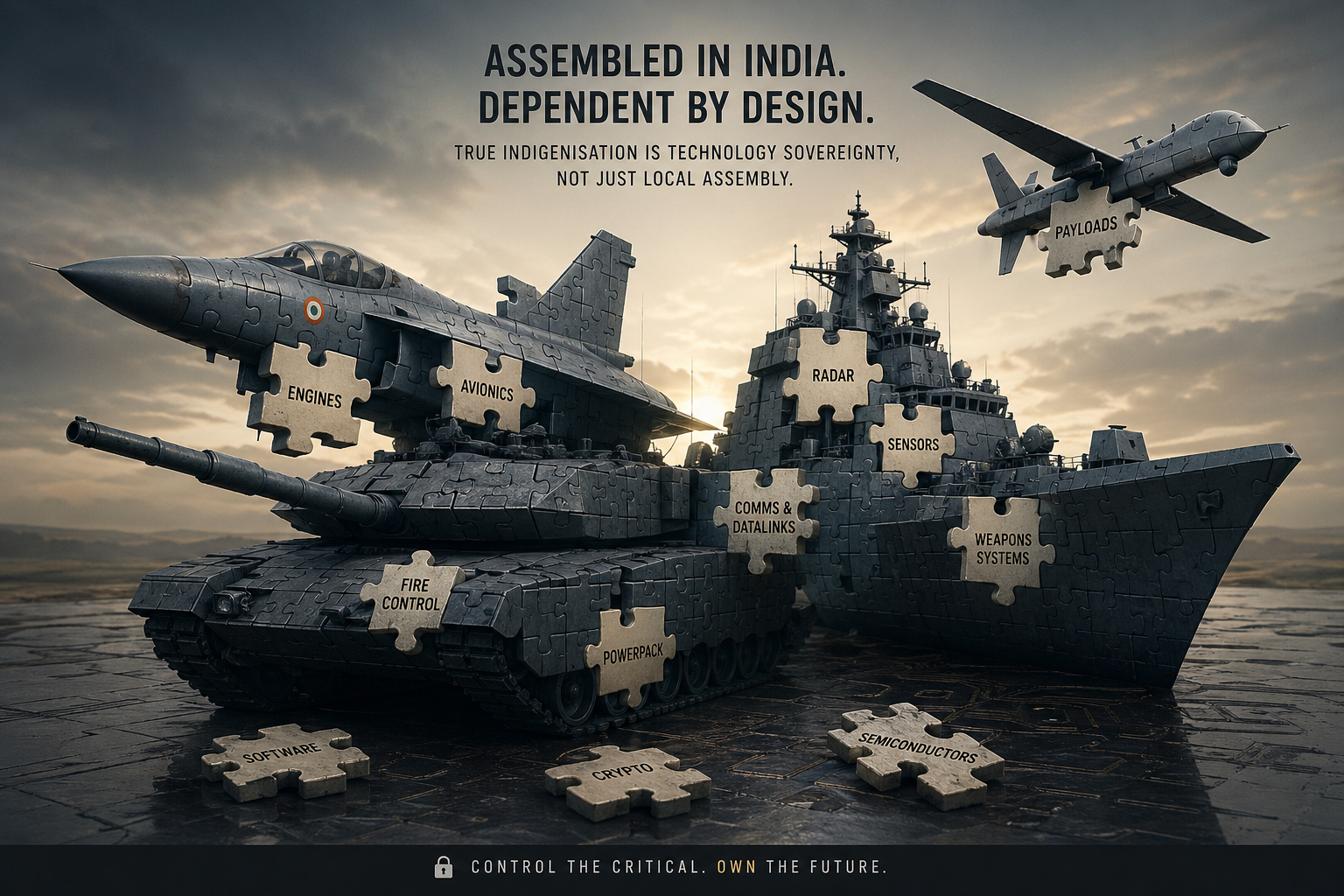
Assembled Here. Dependent Everywhere Else.
Walk through any defence expo in the country today and you'll hear the same confident pitch: Make in India. Atmanirbhar Bharat. Indigenously developed. The brochures look great. The platforms look impressive. Politicians and generals shake hands in front of gleaming hardware.
But lift the hood, and a different story emerges.
India is genuinely getting better at assembling defence hardware domestically. That's real, and it matters. But assembly is not indigenisation — and confusing the two is becoming a strategic liability.
The radar on that "Indian" aircraft? Imported. The engine powering that helicopter? Foreign OEM. The mission computer making targeting decisions? Designed abroad, integrated here. The encryption module in that datalink? Don't ask.
This isn't a fringe problem. Across much of India's current defence inventory — fighter aircraft avionics, UAV payloads, missile guidance electronics, naval sensors — the high-value, high-consequence components are foreign. What India typically controls is the chassis, the airframe, the hull. The body. The brain often still belongs to someone else.
And in a war, the brain is everything.
"India doesn't need more platforms labelled 'Made in India.' It needs fewer platforms where the answer to 'can we fix this in a war?' is 'we'll have to check with the OEM.'"
Why This Is More Dangerous Than It Sounds
When a platform's critical subsystems are foreign-designed and foreign-supplied, India doesn't just face a supply chain problem. It faces a sovereignty problem.
Consider what happens in a conflict:
A supplier country imposes an arms embargo. Spare parts stop arriving. Sustainment grinds to a halt.
An OEM vendor reaches End of Life on a processor module. The entire weapon system becomes a museum piece overnight.
A software update needs to integrate a new Indian weapon. The foreign vendor says no — or takes three years to approve.
Enemy jamming evolves. Indian platforms can't adapt because the EW suite is a black box owned by someone in France or Russia.
This isn't hypothetical. India's MiG-29 and Su-30 fleets have faced exactly this — sustained serviceability hits caused by Russian spare parts dependency. The Jaguar fleet's modernisation dragged for years partly because of imported avionics and engine constraints. Legacy air defence electronics have been rendered obsolete by a single discontinued foreign component.
In drone warfare — which is evolving faster than any procurement cycle — imported and assembled UAV platforms can become tactically irrelevant in two to five years if you can't update the payload or the software yourself.
The Metrics Are Broken
Part of the problem is how indigenisation gets measured. "Local content percentage" sounds rigorous. It isn't — not the way it's currently applied.
A platform can score high on local content by weight or volume while the strategic components — the sensors, the guidance systems, the processors — are entirely foreign. A heavy airframe skin made in India plus an imported radar, engine, and mission computer still gets called "Made in India."
The government's own procurement framework has a category — Make-III — that explicitly permits domestically manufacturing non-indigenously designed systems. That's import substitution, not indigenisation. It's a useful stepping stone. But it is not the destination, and calling it one is dangerous.
What India actually needs to track — and rarely does — is design ownership. Does India hold the IP? Can Indian engineers modify the firmware? Can the software be upgraded without OEM permission? Can the system be integrated with new Indian weapons without asking anyone's approval?
That's the real scorecard. And on that scorecard, the numbers look very different.
The Questions No Procurement Metric Currently Asks
- Does India hold full IP and design ownership of the architecture, source code, and critical algorithms?
- Can Indian engineers modify the firmware and hardware without OEM approval?
- Can the system be upgraded or weapon-integrated independently during a conflict?
- Is the critical subsystem manufactured domestically — or merely assembled here from imported components?
- What happens if the foreign vendor exits — EOL, sanctions, or geopolitical disruption?
What Genuine Indigenisation Actually Looks Like
The domains India must own — not assemble, not license, but own — are not a mystery. They've been identified repeatedly by defence researchers, strategists, and the DRDO itself.
Turbofan / turbojet / turboshaft engines. Small UAV/UCAV propulsion. Rocket motors and ramjets.
AESA radar TR modules. RF seekers. Anti-jam GNSS. Inertial navigation systems. EO/IR detector arrays.
Mission computers. Trusted processors. Embedded RTOS. AI/autonomy stacks. Tactical networking SDRs.
Advanced EW suites. DRFM jammers. ECCM cores. Cyber-electronic warfare integration.
Defence-grade composites. Radar absorbent materials. High-temperature alloys. Energetics and propellants.
Satellite ISR payloads. Space-grade electronics. GNSS-independent navigation systems.
These are the nervous system of modern warfare. India has credible capability in some of these areas — DRDO's work on EW, BEL's radar programmes, ISRO's space-grade electronics — but the depth and production scale needed for wartime self-sufficiency isn't there yet across the board.
Closing that gap requires more than procurement policy. It requires long-term demand signals that give industry the confidence to invest in deep-tech manufacturing. It requires fixing the qualification timelines that currently make it nearly impossible for startups and MSMEs to enter the defence supply chain. It requires separating, in policy and in metrics, the difference between assembled in India, manufactured in India, and designed in India.
iDEX and the Technology Development Fund are steps in the right direction. So are the Positive Indigenisation Lists. But incentives and lists don't build an engine or design a seeker head. Sustained, patient, unglamorous engineering investment does.
The Honest Conversation India Needs to Have
Make in India has done something real: it has signalled intent, mobilised industry, and begun shifting procurement culture. That's worth acknowledging.
But the harder conversation — the one that doesn't make it onto expo brochures — is this: intent is not capability, and capability is not sovereignty.
A defence industrial base that can assemble platforms but cannot sustain, upgrade, or adapt them independently in wartime is not truly self-reliant. It is domestically assembled, foreign-dependent, and wartime-fragile.
"Assembly is not sovereignty. Licensed production is not indigenisation. Import substitution is not technology mastery."
Unless India measures and incentivises true critical-technology ownership, "Make in India" risks creating exactly what it set out to dismantle: a defence industrial base that looks capable on the parade ground and discovers its vulnerabilities only under fire.
The question India needs to answer — platform by platform, subsystem by subsystem — is not "Was this assembled here?"
It's "Can we fix this in a war?"