A Rare Window of Opportunity
There's a lot of excitement around defence startups in India right now, and rightly so. The country is pushing hard for self-reliance, the government is backing innovation, and young engineers are stepping into areas that were once dominated by large public sector units. But if you look a little closer, the story is more nuanced. The opportunity is real. So are the challenges.
It has been a couple of years since my service in the IAF and moving into the corporate world. Leveraging decades of service experience turned out to be a significant advantage , having seen both sides, I can easily relate to the ongoing issues. The talent, zeal, and capability in many startups is humbling. The energy is extraordinary. Young entrepreneurs dream of overnight success, and rightly so, they are ready to take up the challenge, accept the risks, and they believe they can achieve it. But for most who want to make it big in the defence startup domain, it usually comes to an excruciating, grinding halt. I have experienced this first-hand while mentoring a startup.
India is trying to move away from being one of the world's largest defence importers. That shift alone has opened the door for startups in drones, AI, surveillance systems, electronic warfare, and more. Initiatives like iDEX and Make in India have made it easier to get started. There are grants, defined problem statements, and, at least on paper, a pathway to work with the armed forces. And we are seeing results. There are now thousands of startups working in or around defence. Some have even secured orders and moved beyond the prototype stage.
What Success Actually Looks Like
If you study the startups that have made progress, a few patterns emerge:
Took over a decade to reach maturity. Defence is a long game — not a sprint.
Succeeded by building genuinely differentiated technology — not incremental improvements.
Aligned closely with real operational needs rather than building in isolation from the user.
"Success in defence is slow, deliberate, and deeply tied to real-world use cases. This is not a space for quick wins."
Where Things Start Getting Difficult
Despite all the momentum, founders quickly run into structural challenges that are not immediately visible from the outside.
The Procurement Wall
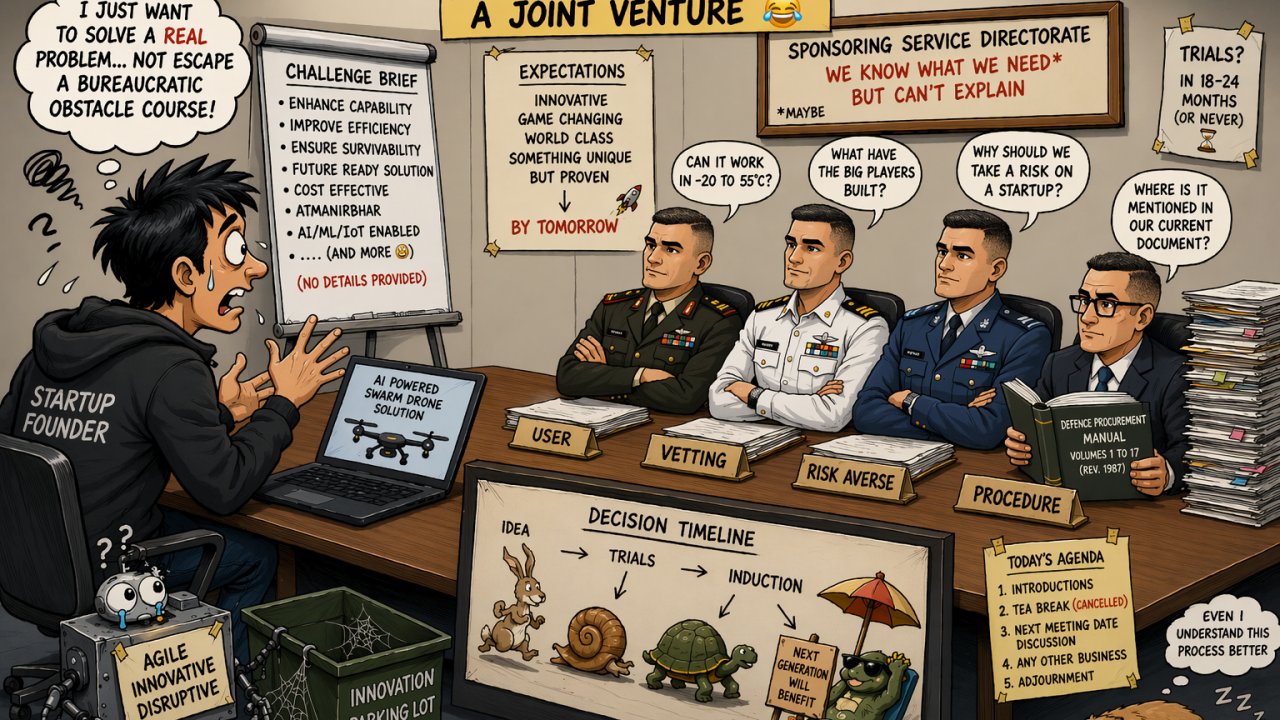
Even after building a working prototype, converting that into a large order can take years. Processes are complex, layered, and often unclear. The policies as laid down don't help either. A startup can build something genuinely excellent and still spend three years in evaluation limbo.
The Funding Gap
Early-stage grants exist, but scaling a defence product requires sustained capital. Revenues are delayed, and private investors are often hesitant because timelines are long and unpredictable. Defence is not suited to traditional venture timelines — it requires patient, long-term investment that India's VC ecosystem is not yet structured to provide.
The Cultural Mismatch
Startups move fast and iterate. Defence systems demand reliability, certification, and zero failure tolerance. Bridging that gap is not straightforward. Field trials add another layer of risk — a single failed trial can set a company back significantly, sometimes fatally. And policies, while improving, still change often enough to create dangerous uncertainty for companies with 18-month product cycles.
Attending a VC hosted by iDEX with the sponsoring service directorate is often an exercise in frustration. Broadly framed, poorly conceived challenges meet the hard realities of operational use, with little alignment between the two. It is rather like being handed a recipe that says "make something delicious," only to discover the kitchen has no ingredients, the utensils are locked away, and the chef judging you won't tell you what cuisine they had in mind.
The Core Issue
At its heart, the challenge is not a lack of innovation. It is a mismatch between how startups operate and how defence systems are built and procured. Startups are designed for speed. Defence ecosystems are designed for certainty. Until these two ways of working align better, friction will continue.
The service HQs and controlling directorates need to scrutinise the challenges they put up for iDEX far more carefully. In my personal experience, I have come across certain challenges that felt straight out of a Christopher Nolan science fiction film. Indian startups do have the talent and the capability, but the industry is not yet ready to realise the production volumes. India does not yet possess certain enabling technologies. DRDO and IITs are working on this, but it may take years to fructify.
"The truth is harsh but someone needs to say it: innovation without industrial readiness is just a very expensive prototype."
What Could Make a Real Difference
There are a few structural changes that could significantly improve outcomes for the entire ecosystem:
- Clearer, time-bound procurement pathways. If a system works, there should be a predictable route to induction , not an indefinite holding pattern of evaluations.
- Shared trial risk. Expecting small companies with 12 employees to absorb the full cost of a failed field trial is not sustainable. Risk needs to be distributed.
- Patient capital. Defence is not suited to traditional VC timelines. India needs investment structures, potentially government-backed — designed for 7–10 year horizons.
- Continuous collaboration. Closer engagement between startups and the armed forces during development is far more effective than one-off, high-stakes evaluations at the end.
- Early global market access. Startups should be enabled to explore export opportunities early. Relying on a single domestic buyer makes every company existentially fragile.
Israel's defence startup ecosystem — built around SIBAT export facilitation, mandatory co-development with the IDF from day one, and long-term patient funding through BIRD — offers a template that India could adapt to its own context. The common thread: institutional speed matching startup speed.
A Broader Perspective
India does not lack talent. It does not lack ideas. It does not even lack intent. What it struggles with is speed at the institutional level. And that matters, because technology is evolving faster than procurement systems can track.
Defence startups in India are not failing, they are navigating one of the toughest operating environments imaginable. The ones that succeed will do more than build companies. They will shape how India designs, builds, and deploys its own capabilities.
The ecosystem is beginning to take shape. The real question is whether the system can evolve fast enough to support it, because the window of opportunity that exists today will not remain open indefinitely.