The Legacy Wall, and Why It’s Not Coming Down
Across the world, nations operate air defence networks built across five decades. These systems, ground radar arrays, command centres, weapons control infrastructure, represent hundreds of billions of dollars of investment. They work. They are certified. They are trusted with lives. Nobody is replacing them wholesale.
What is happening instead is something more interesting and technically challenging: AI is being layered onto these systems. Not replacing them. Augmenting them. Think of it as giving a seasoned, battle-proven machine a second brain, one that learns, predicts, and synthesises at a speed no human operator or legacy algorithm can match.
The engineering challenge? That second brain needs to talk to a system that was never designed to listen to it.
The most important air defence AI projects of the next decade won’t be built by defence primes alone. They’ll need radar engineers, software architects, ML developers, embedded systems designers, and drone specialists, together.
What Air Defence Actually Does
For the Non-Military Engineer
Strip away the classified context and air defence is fundamentally a real-time, multi-sensor data fusion problem. Multiple sensors, long-range radars, airborne surveillance systems, electronic intelligence receivers, satellite feeds, each report observations about objects moving in the airspace. Each sensor has different update rates, different accuracy profiles, different latency.
The job of the defence network is to take all of those inconsistent, noisy, asynchronous data streams and produce a single coherent, real-time picture of what is in the sky, what it is, and whether it is a threat.
If you have built sensor fusion for a self-driving car, a precision agriculture drone, or an industrial IoT monitoring system, you already understand the core mathematical problem. Kalman filters, data association, asynchronous sensor handling, uncertainty propagation. Air defence is the same problem, running at higher stakes, on hardware from the 1980s.
The difference is scale and adversarial context. Air defence systems must handle hundreds of simultaneous tracks, adversaries deliberately trying to confuse or deceive sensors, and engagement timelines measured in seconds.
Where AI Actually Plugs In
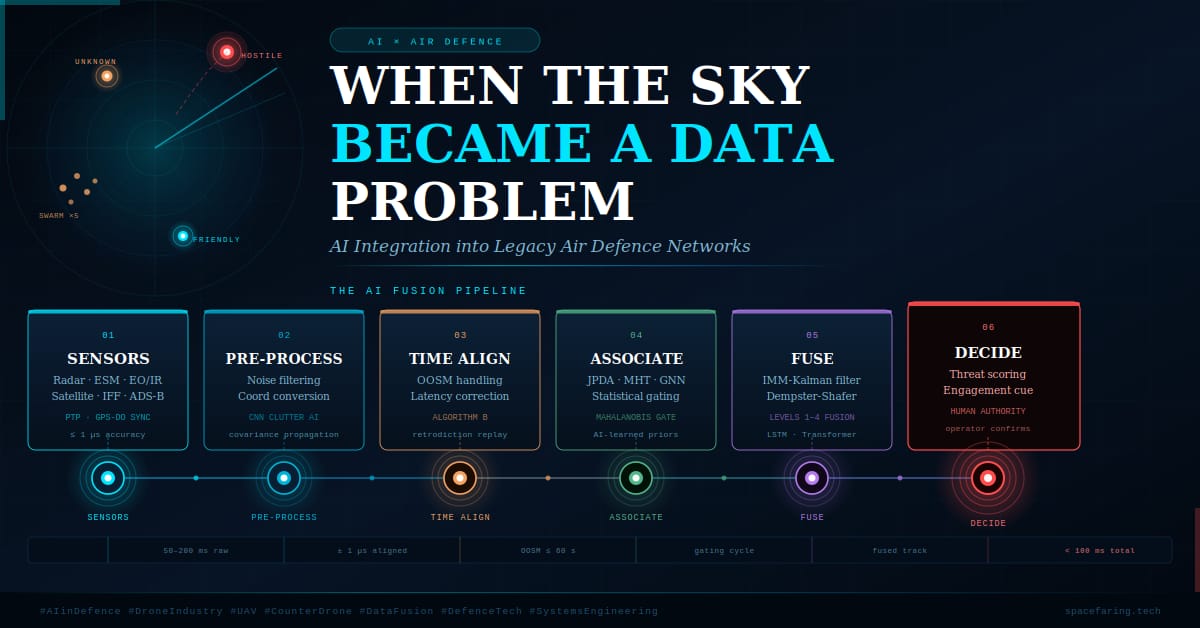
The AI integration is not one technology, it is a stack of six capabilities, each solving a specific engineering problem that legacy systems cannot address:
01, Smarter sensor fusion. AI weights sensor inputs dynamically based on current reliability, automatically reducing trust in a radar being jammed or degraded by weather, without waiting for an operator to intervene.
02, Asynchronous data handling. Legacy systems discard late-arriving sensor data. AI-integrated systems handle out-of-sequence measurements mathematically, reconstructing the correct timeline even when satellite feeds arrive minutes after the event.
03, AI target classification. Neural networks classify targets from radar cross-section profiles, electronic emissions, and thermal signatures, faster and more accurately than the fixed rule-sets encoded in legacy systems thirty years ago.
04, Intent prediction. LSTM and Transformer models analyse trajectory patterns to estimate whether a contact is conducting a reconnaissance pass, a feint, or a terminal attack approach, before the geometry makes it obvious.
05, Conflict detection. AI cross-checks sensor reports for internal consistency, flagging GPS spoofing, radar deception, and false electronic emitters before they corrupt the tactical picture and trigger a wrong engagement decision.
06, Decision support. Threat scoring, engagement priority recommendations, and engagement window optimisation, all with explainable reasoning surfaced to the human operator, who retains authority at every critical decision node.
You Are Already Inside This Problem
If your startup or company is building drones, counter-drone systems, UAVs, or autonomous aerial platforms, you are not on the periphery of this shift. You are at its centre.
The proliferation of commercial and military UAVs has fundamentally broken the assumptions that legacy air defence was built on. Those systems were designed to track a handful of large, fast aircraft. They were not designed to track a swarm of 50 low-radar-cross-section drones flying coordinated evasive profiles at 30 metres altitude, communicating autonomously, and presenting no IFF response.
This has created the most urgent near-term AI integration requirement in the entire sector: multi-object swarm tracking, classification, and engagement management, a problem that directly draws on the same autonomy, computer vision, sensor fusion, and flight control expertise that drone-sector engineers build every day.
The question your company should be asking is not “how do we sell drones to defence?” It is: “what does our sensor fusion, autonomy, and data architecture capability solve for the detection and engagement problem?” That reframing opens a very different set of doors.
It Takes an Ecosystem
The Technical Disciplines This Work Demands
The AI integration of legacy air defence is genuinely multi-disciplinary. Here is a direct map to the engineering specialisations this work requires:
- Embedded systems and real-time computing engineers, AI inference on ruggedised VPX/FPGA hardware achieving deterministic sub-100ms latency on classification and fusion outputs under peak target load.
- ML engineers specialising in time-series and sequential data, LSTM, Transformer, and Bayesian network architectures that run inference at sensor cycle rates, not cloud batch rates.
- Communications and protocol engineers, adapter layers translating legacy military data formats (Link 16, ASTERIX, MIL-STD-1553) into modern message broker architectures without introducing new latency.
- Precision timing engineers, IEEE-1588 PTP synchronisation retrofit onto sensor networks; the AI fusion engine demands sub-millisecond temporal alignment that legacy systems were never designed to provide.
- Human factors and UX designers, explainable AI interfaces that allow operators to understand, calibrate trust in, and override AI recommendations under combat stress. A threat score without an explanation is operationally worthless.
- Systems architects with certification expertise, navigating MIL-STD-882E, DO-178C, and emerging AI-specific safety standards for components in safety-critical weapon system paths.
The bottleneck is not the AI. It is the engineering infrastructure to deploy it reliably, safely, and certifiably on fielded hardware, that is where the talent shortage actually lives.
What Nobody Talks About at Conferences
The gap between a compelling AI demonstration and an operationally deployed system is large, and in defence it is larger still. Three things need to be said plainly.
First, training data is the hardest problem. AI models for threat classification need examples of adversarial threats, novel platforms, and contested EW environments. By definition, these are underrepresented in historical data. High-fidelity simulation and synthetic data generation are the foundation of the entire AI training pipeline.
Second, correlated sensor errors will break naively designed fusion systems. Multiple sensors sharing a GPS timing reference or common RF infrastructure produce correlated errors that, when fused without accounting for that correlation, create overconfident state estimates. Covariance Intersection and correlation-aware fusion design are engineering necessities, not theoretical niceties.
Third, meaningful human control is non-negotiable, both operationally and legally. Every AI recommendation in an engagement chain must be explainable, overridable with a single confirmed action, and auditable. Engineers building for this space need to design for human-machine teaming from the first line of code, not as an afterthought.
Defence customers will ask for certification evidence, cyber-hardening documentation, latency budgets under peak load, and graceful degradation guarantees before a contract is signed. Build your architecture to answer those questions from day one. The technology is the easy part.
The Opportunity
The AI integration of legacy air defence networks is one of the most technically demanding and consequential engineering programmes of this decade. It is also one of the most open, because the skills required are distributed across commercial technology, the drone sector, academia, and defence primes in a way that demands new collaboration structures.
If you are a systems engineer, an ML developer, an embedded hardware designer, a precision timing specialist, or a human-factors researcher, and you have wondered whether your skills are relevant to defence, the answer is yes. More precisely, your skills may be exactly what this programme cannot do without.
And if you are building drones, counter-drone technology, or autonomous aerial systems, the multi-object tracking, swarm management, and sensor fusion work you are doing today is the most directly applicable technology transfer opportunity in the sector.
The sky became a data problem a long time ago. AI is finally giving us the tools to solve it. The engineers who can bridge the commercial and defence worlds, who understand both the IMM-Kalman filter and the startup funding cycle, are the ones who will build what comes next.